
CHILD OF LOTHIAN
LEVEL DESIGNER
Project role
UNREAL ENGINE 4
Engine
12 MONTHS
Duration
The beautiful culture and atmosphere of 18th century Edinburgh disappearing beneath the shadows of witch hunters looming in the streets. Hushed whispers appearing in every corner and suspicious gazes of townspeople falling upon their neighbors as friends become enemies. What is your role to play as a child, in the 18th-century witch trials?
PAGE NAVIGATION
ABOUT
KATHERYN
Become Katheryn, a recently orphaned girl, who is accused of witch craft. Katheryn is learning how to use her sling and stealthily traverse in order to survive the streets of Edinburgh.
THE OLD TOWN OF EDINBURGH
Explore the winding, damp streets of the old town on your journey to survive the witch hunts. The town is full of secrets and characters to meet and interact with. Every problem has its own set of solutions and completing errands for the town-folk leads to different outcomes. Make your own choices and live to see the consequences.
THE WITCH HUNTER
In an era of widespread fanaticism, witch hunters are roaming the city, searching everywhere for witches. These relentless zealots have accused, judged and executed your family. The witch hunters are onto you and will stop at nothing to hunt you down.
PROJECT ROLE
During the 3rd year of my enrollment at Breda University of applied sciences we had to do a year long project with a large team of on average 25 people. Everyone got assigned a creative brief stating the basic premise of the game you would be creating and a project role of your choosing. For this project I took it upon myself to be a level designer.
As a level designer...
-
Recreation of historical Grassmarket area as playable world
-
Implementation and iteration of onboarding quest using in-house tools
-
Create simple interactive objects through blueprinting
-
Setting up pipelines and metrics for level design
-
In charge of keeping up with the progress of level design
-
Setting up meetings
-
Setting next priorities
-
Keeping track of risks and blocks
-
THE GRASSMARKET
Gamefying 18th Century Edinburgh
One of the first things that was set in stone for this project was it’s setting: 18th century Old Town Edinburgh. This immediately led us to one problem, how do we immerse the player into the experience of wandering the streets of Edinburgh? For this we decided that we would start of the game in one of the most recognizable locations of the Old Town: The Grassmarket.
To recreate the Grassmarket area within our game I researched old 18th century maps and cross-referenced those with the present-day layout of the Grassmarket. This way I could find the right balance between keeping it recognizable as people know it today, while keeping in mind historical accuracy.

Reference gathering

Early planning playable area
Creating the market
Underneath are images showing how the concept slowly progressed from very early blockout, to first art pass by me, to final art pass done by the environment artists working on the project. Iterations were made based on environment scope, performance and the desired player experience as dictated by our player persona and playtesting performed during development.


First blockout


First asset test
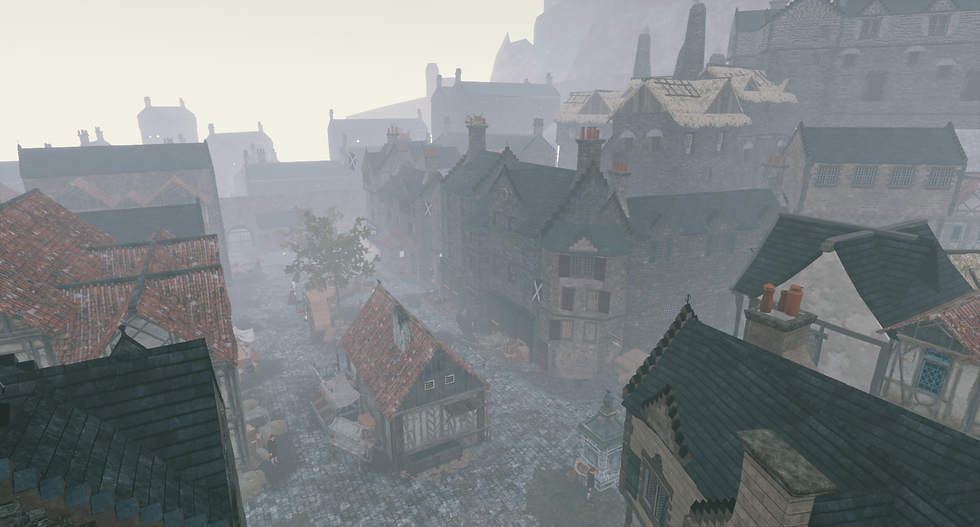


Final version
Final layout of the Grassmarket

QUEST DESIGN
Open vs. Linear
For the game we used two types of quests. Linear quests and more open ended quests that even give you multiple ways to solve them. The linear quests were used as a tutorial for the player, teaching them specific mechanics and taking them through special designed environments so we could have maximum control over what and how we teach the player to play the game. The open ended quests were used in later areas to encourage the player to experiment with different routes and see in how many different ways to can complete their objectives.
My own process for designing the linear onboarding quests was to follow the following steps:
-
Determine mechanics/features that need onboarding
-
Sketch out a wide variety of scenes explaining the mechanics
-
String the scenes that create the best gameplay flow together
-
Build in engine and set up the quest logic and dialogue trees
-
Playtest, iterate, repeat
The open world quests I instead designed around the available gameplay space, making the player explore and figure out their own path in solving a certain problem.

Linear quest scene exploration
Planning a quest
Full onboarding quest playthrough
In-house tools
Using two in-house tools (developed by one of the technical designers) the level designers could easily create quests and tie them into the dialogue system. Dialogue trees would be planned out in advance and then implemented through the tool were we had options to branch dialogue based on choices, collected items, active quest steps, booleans and more.

Dialogue tool

Quest tool